One of the perks of being connected through various online groups is that people from all over the world share various opportunities. A few months ago, one of the opportunities that I came across was to be a guest presenter on a (live streaming) YouTube show: The Suite Talk with Kimberly Mattina. Due to various delays on both ends, it took a few months to sort out a time that worked (I am the farthest guest by a wide margin) but yesterday the stars aligned and I was able to make it.
Here's the video if you'd like to hear me talk about Digital Breakouts and how you can make them (plus a few hints to some breakouts I've made!).
I really enjoyed the experience and am definitely keen to do these types of things in the future (so keep an eye out for that!).
So far there have been 67 views on the video. It's not a HUGE amount, but it's still a pretty decent impact. I hope that some of the viewers got something out of it.
If you're interested in learning more about how G Suite can be used in the classroom, check out the other episodes in the series.
Today I watched the 9th and last video from the Hive Summit. I am a bit saddened that it is over, but I've had a great time (even though it's been very hard to fit them all in - what with New Zealand being in the middle of term and all) and got lots of ideas.
This last video starred Dave Burgess of Teach Like a Pirate Fame where he talked about a variety of amazing ideas that any and all educators can learn from. He first started telling us about how he came to be where he is. A long time ago (or maybe it wasn't all that long ago) he was doing some great things in his class. But not many people knew about it. One day he decided to present at a conference and from there things started snowballing. He shared a lesson that he learned and that lesson is to share. Dave suggests that everyone should take a chance, be brave and present. By doing this, it makes you think and reflect upon what things you're doing that are awesome and amazing (and no doubt, everyone is doing something awesome and amazing). It's a chance to start a conversation and to help improve your own practice. In my experience, you don't need to have a perfectly formed idea to present, all you need is an idea.
Dave then goes on to talk about those ideas. Not every idea that you hear, even if it's a great idea, will be one that you want or need to adopt in your classroom. And that's ok. We are all individuals and all have different ways of doing everything. There is no one right way to do anything and as educators I think we need to embrace that. Learn about a lot of different ideas and then take the best of everything that will work for you. Mix and match. There are so many great ideas out there and so many ways to inspire children. Do what makes you the best educator that you can be. And don't forget to share the things you're doing so that others can take the best bits of what you do. I like how I summed it up in a tweet best:
Teach like you. Take all the amazing ideas and integrate them to be the best you that you can be. But teach like you. @burgessdave#HiveSummit
He also talked about how often he would go to conferences to present, and how he spent a lot of his own money and time to get out there. That naturally led into a talk about what you can do if you can't afford that or there isn't anything near you. He talked of a ski and snowboarding resort that would sometimes not get snow. But when there was no snow, they didn't just close up shop. They made their own snow. If you don't have access to the community that you need to grow, make your own. Or join one of the myraid of online groups (that's been a pretty big theme throughout all nine videos) and join the community. These groups are not about listening to one person and everyone copying those ideas in the classroom. It's the mix of people that make the PD and the space what it is, not the person in charge. The main point is though, to find a group that works for you.
Some other great advice that was given in the talk was that at the beginning of the year you should spend the first few days on making your classroom or learning space a safe and exciting community. You want to make children so excited on the first day that they can't wait to come back on the second. Most classes (I know I've done this) spend lots of time going over all the minutiae of the rules and regulations but is that what you want children to go home thinking?
He also spoke about putting on a show. Often people get confused and think that you have to be "on the stage" all the time. But that's not what he's advocating. Spend a little bit of time on the show, get the kids hooked in (love the pirate analogy for this) and then have them doing the amazing things that will help them learn: collaborating, connecting and creating. He says, and I completely agree: "We want makers not memorizers; creators not consumers."
I have thoroughly enjoyed this talk and every other Hive Summit talk. I hope that I've managed to help amplify the amazing voices and ideas of those that were sharing. I'll leave you with what Michael Matera left us at the end of the video, because it's such a good message:
I'm slowly getting to the end of the Hive Summit and I'm continuing to be inspired by the amazing people and amazing topics being discussed. The penultimate video has Joe Sanfelippo discussing ideas around Hacking Leadership, or how to be an effective leader. This topic is (like many of the other topics) near and dear to me. I am taking up one of my first official leadership positions very shortly so I'm looking for ways to help build something amazing.
In a very enthusiastic way (gung ho might be a better word to describe it), Joe tells us about three things that are important for leaders to do: Be intentional, open doors and build staff.
Being intentional is something that leaders, whether you're leading a classroom, team, school or district need to think about. It means that you do things for reasons; that there's always a why to your actions and that why has to do with the results you want to achieve. A lot of this revolves around role modelling, but also includes making choices in when and how you do things. An example he gave was that in Wisconsin, many people would be watching Green Bay Packer games on Sundays. If you want to share on social media, some people would be sharing things at the same time commercials were on for the games - that way when people went to their social media feeds theirs would be the top stories. I think that example is the best because it just shows the cause and effect relationships between actions and desired outcomes. As a leader you need to think like this in order to help accomplish what you want. Be VERY mindful of how to achieve your lofty goals.
Opening doors is the idea that you need to share what you're doing and put yourself out there. This doesn't mean necessarily sharing what an individual is doing, but what the collective team is doing. It's never really about me, or I. It's about we and us. Letting the world know the things that are going on in your school is important to starting and continuing a dialogue.
This can be a very scary idea for many. There is a lot of judgement that occurs, but in order to accelerate our progress we need to share what we've done and what we're doing. There are many different ways to share, and not one is better than the other, though it does change your audience slightly. The point isn't which platform you should share on, but that you should share. Make things visible and transparent.
Building staff is very important. As Joe said in his talk, you need to make people feel like they are a apart of something bigger than themselves, like they are not isolated and like they have control of the direction of whatever organization they are a part of. There's nothing worse if you just go to work (or school) and someone tells you what to do and doesn't let you grow. Joe spoke of something that my new school is in the process of doing, and that's Passion Projects for staff. I can't push that idea any more. It's absolutely brilliant. I've been facilitating projects like this with students for years now, and it only makes sense to allow educators to do the same - but authentically, not based on someone else's ideas.
While watching this, I couldn't help but notice a huge link to the Project Culture Shift ideas that I've been learning about lately as well. The four main areas for that are: Collaboration, Agency, Risk Taking and Curiosity. I think the ideas that Joe spoke about in his talk align completely with this, and since I'm going to be a part of that, his ideas have helped me with some really good ideas and insights.
This was yet another amazing Hive Summit talk. There's only a few more days left to watch the videos so I urge you to do so if you haven't yet. And you're reading this and it's too late, look these people up, read their books, see what they're doing. There's tons of amazing ideas in this!
This week I did something that I've wanted to do for a while now: bring learner presenters to an adult conference or summit. After my previous attempts to do something even grander failed, I wasn't going to take no for an answer in bringing children to the EdTechTeam Auckland Summit.
We had a busy term so our preparation was left to the last week of term. Maybe that was not ideal, but it was enough. The plan was to bring 16 of our learners and all four learning coaches from our Habitat. We had four presentations and they were all scheduled for the first day of the summit. We worked extremely hard over those five days at the end of the term. The learners actually were given a lot of leeway to come up with what they would say. I made the slides for the sessions and practiced with them, but for the most part they were on their own.
On the day, I was nervous and the children were nervous. We arrived fairly late due to one of our learners not showing up on time. I guess that was to be expected. We managed to get everyone lanyards and some nice free Google Cardboards courtesy of EdTech Team (who were extremely supportive of what we were trying to do for our learners).
For the most part the children weren't too interested in what the adults were saying (though some were) but they came prepared and even if they weren't listening, they all had a device to do something on while we adults were being inspired.
Overall, the children did an AMAZING job in the presentations. They were clearly nervous and some of them spoke extremely softly. Others forgot their lines or got mixed up, but the issues were minimal. Where they absolutely shone, though, was when they were helping out the adults at the sessions. Several of the children chose to stay back in the room with me and help out at the sessions that weren't theirs. They were so excited and happy that they knew more than adults and that they could show them how to do things they couldn't do. On the drive home, one of the girls told me that that was the first time that she had told an adult what to do.
The day was a complete success and the feedback from all four sessions was overwhelmingly positive. I'm excited to go back after the school holidays and see the effect it has on them.
An interesting side note to the whole day, was that they were clearly more up to date on some new features in YouTube than many in the audience - a fact that was continually brought up on the second day of the conference.
I'm so proud of all the learners who came with me to share. They were very brave and they took advantage of an opportunity that they were given. I definitely will look at increasing the frequency of events like this in the future.
About a month or so ago, I made a digital breakout for Maori Language Week. I had been wanting to do one of these on my own for a while now, and there was an opportunity to do so, so I took it. I even wrote about it here. Though the children that tried the breakout at my school (well the ones that tried it initially) gave up very early on, I enjoyed the creation of the breakout so much, I decided to do another one for the New Zealand election which was the following week.
Sharing these two resources that I made on the New Zealand Primary Teachers' Facebook group got me lots of positive feedback - and lots of schools using them.
I thought the logical thing would be to keep on making them, since I liked the act of creation and others liked using them.
Basically a digital breakout is a Google Form embedded on a Google Site. The form has special data validation which stops users from submitting the form if what they enter doesn't match the criteria I set. Thus, I can create a digital lock. The form is embedded on a site, where clues and links to clues are also embedded. There is no exact science to how the clues work and I have had varying success on finding clues that are hard enough to keep learner interest, but not too hard that they frustrate everyone and, to quote one my learners, make them "rage."
In future posts (and most likely at the New Zealand Ed Tech Team Google Summits as well as hopefully at ISTE 2018) I'm going to share how to make these more in depth. I'm currently designing a workshop for learners on this idea - which will start next week - so that will give me the chance to make it very clear. So for now, I'll leave the HOW I did it.
What was very interesting to note (and I know I've spoken about Breakouts and BreakoutEDU before), was the evolution of how my learners approached the breakouts.
Initially, the learners gave up quite quickly when it was obvious they couldn't get things straight away. I've noticed this with a lot of the children in other settings, so I wasn't that surprised. On further attempts, some of the learners got really into it and worked hard to solve the clues (though some tried the guess all the numbers approach, which worked when the number was low, but not so much when it was high). They began to share what they got and work together. Then others picked up on what to look for. Suddenly, clues that I thought were too hard were getting solved rather quickly by the children. They were beginning to look at things in a new way, looking for those hidden patterns.
The last one we did as a whole habitat (Roughly 90 learners in four teams) was quite difficult. Most groups were unable to even get one clue, even with multiple hints. I guess what I need to do as I continue to create more, is to find a way to level them. Some are obviously harder than others. I probably should be collected data on the people who break out based on their ages, that way I could at least get an idea as to how difficult they are (the Diwali one, which caused my learners so much trouble was actually solved by quite a few others).
At any rate, the engagement level on these has been pretty high in my experience and with a lot of the feedback I've received from other educators across New Zealand. I'm looking to continue making these until I've exhausted all ideas (or I can sell them all and live off the interest on the profit). If you have any ideas for me that you want me to make, put them in the comments and I'll add it to my list. My learners have enjoyed helping me make these (though I'm pretty clever at not revealing the clues or locks to them) and they are loving it too!
Until then, have a look at the breakouts I've made. Try them. See if you can break out. Share them with your friends or your students. You won't regret the engagement that comes out of it!
This past term I ran a Stop Motion workshop at school for a writing project. I had about 50 learners from my Habitat sign up for this choice, so I was pretty excited for that, though a bit wary of managing the groups.
We only have 10 iPads (plus a few BYOD devices) so through necessity I had to put the children into groups of 4, though at the smallest, I would have had three, so it worked out pretty well. I let them choose their own groups because I wanted them to be mixed up as much as possible. I figure (and have figured for a while) that they all have something to bring to the table. Even if they are not great writers they still have some great ideas. Grouping them helps ensure that they'll come up with some amazing ideas and that they'll likely have the skills they need to do what they want to do. Or at least a better chance of it.
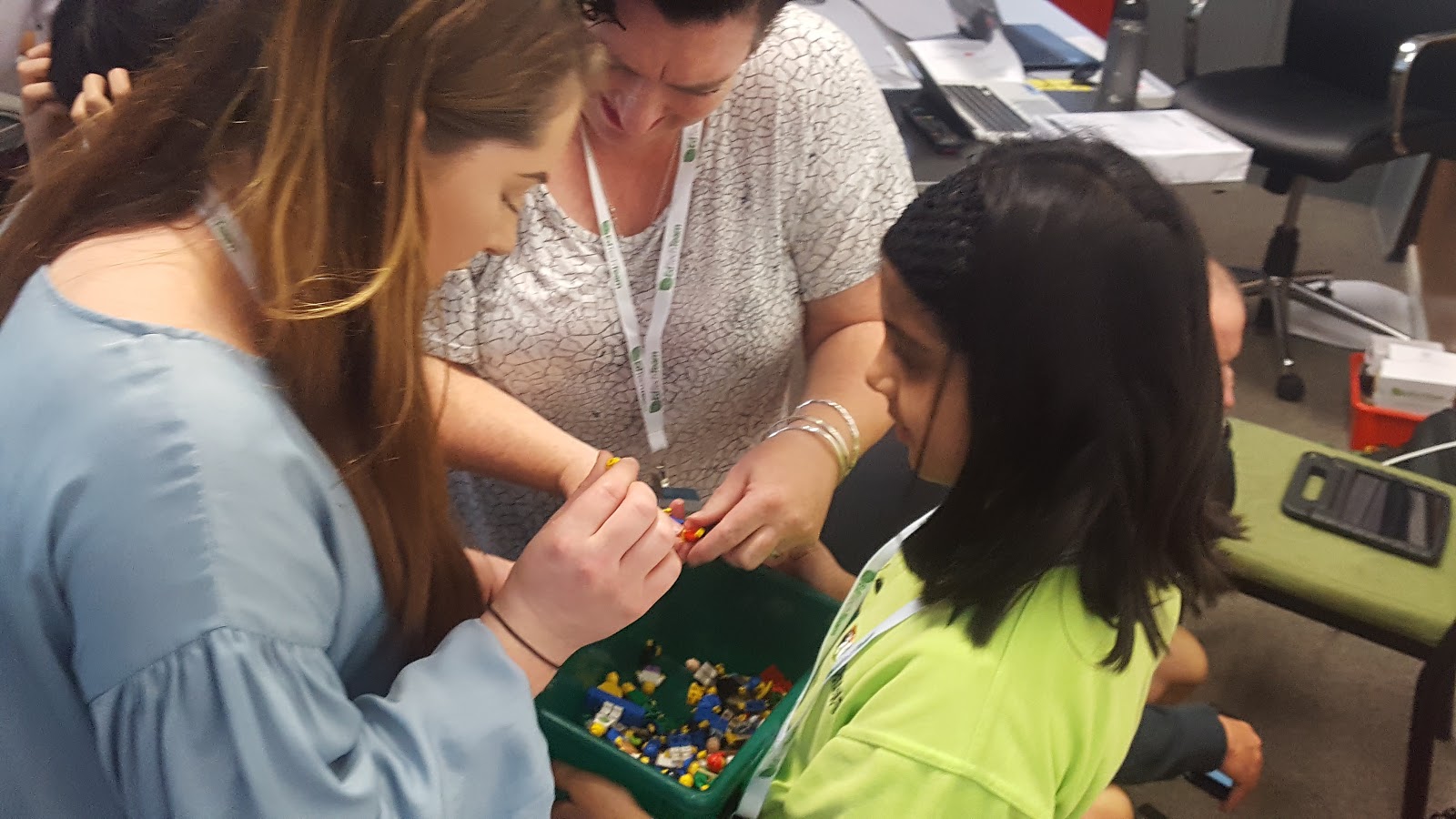
Previously, we had offered Stop Motion as a choice and it had turned into something of a disaster. For starters, we were unable to properly support the learners in this endeavour when it came to planning out a story or in actually filming it. This term we had decided to give less choice (but still some pretty awesome choices - the two other workshops that ran were making a newspaper and making storybooks) so we could focus our direction. So I started this term with having the learners plan out their story roughly. I did give them the option of using a variety of materials, but all the groups but one chose to use Lego in the end (which was great because I had just brought all my childhood Lego back from Canada).
Here is how I had them plan out the story. I decided that I wanted them to have more than 1 scene, and since we all love the 5 parts of a story, I gave them five boxes. But what I didn't do was tell them that the story had to have specific parts (eg the introduction, build up, dilemma, resolution and ending - or whatever five parts you call them). I wanted to make them think that things had to be in a sequence, but at the same time I didn't want to limit them.
The next thing I had the groups do was to write a script. I gave them an example, which included stage directions. To me, this was important. While I did want the learners experimenting with the Lego to come up with their story, I also wanted them to put some good thought into their story beforehand, so they didn't start the story without knowing where it was going. This writing took a while, but in the end, the discussions that came out of it were incredible and the quality of the stories definitely benefitted (for the most part)
Not all scripts were this good, but I particularly liked this groups' because they put lots of directions (and if you watch their movie they may have actually said the directions as well - which was helpful in determining what was going on).
The last part of the project (ok, it was actually two parts, but the second part of this was much easier than the first) was to teach the children how to actually use the technology (which in this case was an iPad and the Stop Motion App). The biggest issue the learners had had when they had worked without guidance was how to actually film the video. They would often just take a picture while holding the camera and then move somewhere else and take another picture. The videos were all disjointed and didn't really make sense. So, with 50 children all around me, I showed them how to set up the iPad so that they didn't need to hold it - thank goodness for Airplay! I showed them how they need to make small changes for each picture, not big ones. They mostly took the advice (as can be seen in the videos) so I was pretty happy with how that turned out.
The last part of the last part was to add sound. This was fairly easy once they discovered how to do that. We had a few issues with groups recording the sound, previewing it and then nothing else because they didn't realize they had to click Accept. A frequent frustration that came out of this part of the project was that the people went too fast. Perhaps I didn't quite capitalize on this realization to teach them about how long it really takes for people to talk when you're filming frame by frame. But for the most part the managed to improvise (most just slowed down the speed from 5 frames per second to 4 or even 3).
Have a look at some of their finished projects here:
During the last week of term we had a sharing day for all of the writing projects. We put the videos on a loop in our Media Space and it was quite the popular event. It was really amazing to see their final projects up on a biggish screen and to see them enjoying each others' work.
Overall I was extremely pleased with the results and with what was seen during the process. A lot of the really great bits of learning probably won't even come out of the videos. The sets and stories they came up with orally and the problem solving they had to do with the filming were amazing to watch. At one point during writing time a fellow learning coach and I remarked how we could have walked out of the room and the children probably wouldn't have noticed. They were that engaged and independent.
The one thing that was probably missing was a way to decrease the feedback loop. I probably should have set up a way for groups to share their plans and scripts with each other so that they could get a critical eye and some suggestions. This potentially could have happened throughout the filming stage as well as afterwards to help them in any future projects they might make. That being said, they were working collaboratively so they did have at least an element of feedback from their groups.
So if you have any lego lying around, my suggestion to you is to try this. It's not the first (and definitely not the last) time I've used Lego to try to get my learners engaged and every time the same thing happens: lots of children excited to tell a story! Watch this space for more of the things I do with Lego and learning!
One of the connections that I made at ISTE 2017 was with the Global Collaboration Network and some of its members (thanks to a night of karaoke). A few weeks ago I was sent this tweet:
I was interested in making some more global connections, so I clicked on the link. Having heard a lot about Flipgrid recently but not really being sure of what it was, I decided to give this one a go and changed up my reading plan last minute to read the book (by watching the video below) and having my learners respond to it.
To be honest, while I really liked the book and its message, I was a bit confused as to what my learners were meant to do. Being in New Zealand, we had started looking at this on Monday, which is Sunday in the US, so there had not yet been any entries to the flipgrid yet. So we bumbled about what we were doing for a few days. I had the children make a picture about how they would make their mark in the world. What was interesting was that even though I didn't really give them that great instructions, they all interpreted differently and had some really interesting things to say:
The actual use of Flipgrid was interesting. Essentially there was an online board setup where anyone could post videos (though many of the other videos had a lot of filters on them, which didn't really seem useful) and respond to the videos with videos of their own. My impression beforehand was that this was a tool for flipping a classroom, but obviously the potential of this is far beyond that. Some of my learners did receive some feedback from others and while it wasn't necessarily very deep, it was interesting to see them connect with others around the globe. I like this idea and perhaps I can use it with some upcoming projects I'm trying to plan with some schools overseas. It definitely has the potential to help learners connect with each other.
It is not a completely free resource (though it does have a free version), so I have to do some checking to see if I can get by with the free version, but certainly it is something worth checking out. Global Collaboration, on the other hand, is something I definitely recommend!
Three times before I have applied for the Google Innovator Academy and three times I have received the rejection email with varying degrees of dismay. But each time I refused to give up, knowing that if I kept at it, I would be selected. That being said, I was still quite nervous for this current round, since it was in my part of the world.
I was not to be dismayed this time. While on vacation in New York City, I had a flurry of activity on my phone, which all indicated that I had been accepted. I was extremely busy at the time so it took a while for everything to sink it. After my holiday, I came back to a very busy school term, so was also quite rushed for time. That being said, I still managed to get everything done in time for the academy, which was probably one of the best experiences I've ever had.
If I had to choose what my favourite part of the two and a half days, I'd have a real problem. Pretty much all of it was incredible. The best I can do is point out two aspects of the academy that will likely be instrumental in going forward: The connections with other innovative educators around the globe and the design thinking process.
With me at the academy were 36 other educators, and many coaches and other EdTech experts. My close team, the Lucky Unkos made immediate and strong bonds with each other, and functioned not only as a well-oiled machine in all the activities we did, but also ended up winning quite a few things (or coming close seconds). By going through the process together, we formed something of a family group together and will now have each other to lean on through difficult times. One of my good online (and in person) colleagues was actually placed in this group, so it was nice to have that, but it was also nice to work closely with others in this capacity.
The whole point of the academy was to help each of us work on an identified problem in education and to develop a solution to it through the design process. Though I had had some experience with this, clearly I didn't know enough, because over the 2 and a half days I was immersed into the world of design thinking in a way that I could never have imagined. We started from the beginning by looking at all of the reasons why the problem exists and then examining the person (or people) to whom our solution is directed at. We spent lots of time slowly developing our ideas and giving each other feedback. Eventually we all developed a prototype of what our solution will be.
This process was absolutely amazing and I've already brought in many of the ideas into my practice. In our iExplore block, I've taken four of my groups and run through a watered down (but still pretty robust) version of this with the projects they had been working on. Already the results have been pretty positive with all four groups working on some pretty interesting solutions (so watch this space in the coming weeks when I'll have time to share what they did in more depth).
My actual project is based on helping educators integrate coding into the curriculum. Here in New Zealand, computational thinking is meant to be part of the curriculum next year. Before the academy I did a survey and found that many educators were not teaching it (about 50%) and those that were had had very little training or support. So I wanted to change that. After the whole process at the academy, I decided on making a storyboard of a video for my prototype. I'm currently in the process of turning that storyboard into a script which will then be filmed. It has been a busy few weeks since I came back (mostly taken up with ERO and some big personal things), so I'm hopefully going to find some time in the coming week to work on it. At any rate, I was matched with my mentor today, so that's another great step in this whole process. I look forward to sharing with everyone how this project is going in the future!
Over the last few weeks, I have been privileged to have the opportunity to do some collaborative learning with our local Secondary School - Ormiston Senior College (OSC). One of the teachers there, Mr Chandar K, has been using the Sphero robot in his teaching and had heard that we were using them as well in the primary school. He contacted us and offered to take a small group of our learners and do some activities with them, to teach them how to code the Sphero Robots.
I've had a couple of Spheros (and two Ollies) and have been letting our learners use these all year, but I wanted to learn how I could use these a bit more. We were a bit limited by our small numbers, so the opportunity to use 8-10 of them in another setting was very enticing. We asked the 90 learners in our habitat which were interested and got 18 who were keen to make the once weekly trek through the Junior College to go learn about how to code a robot.
For the past month or so, we've been learning and developing our coding capabilities and I've been getting lots of ideas as to how you can manage a robotics curriculum in a school.
On the teaching side of things, Mr Chandar K started by letting the learners free drive with the sphero. This was the last time he let them do this. We had a couple of races to get them used to how the sphero moves and what it is capable of doing.
From there we did some simple coding - making the Sphero roll for a short amount of time, at a specific speed in a specific direction.
That was the end of week one. When we came back the next week, we tried another challenge: to make the robots go in a square (and then back again). This proved difficult for some learners as they had to change the directions (so we learned a bit about angles), and adjust the speed or time so that the sphero would go the correct distance. Some were able to complete the task AND make the robot retrace its steps.
The third session involved our learners trying to program the sphero around three objects inside a square - so essentially they had to program a triangle. This was also difficult, but many managed to do it.
Our most recent session involved the learners coding the sphero to go in an L Shape on the carpet. We had some difficulties today and discussed concepts like friction (the carpet was pretty bumpy itself, but the little markers used for the shape were slowing the sphero down a bit and knocking it off course) and fractions, ratios & proportions (when trying to adjust the distance the sphero would go). As a learning coach, I am starting to see a lot of the mathematical applications with using a sphero.
As you can also find out in the video, we learned about putting a delay between roll blocks so that the sphero goes in straight lines, instead of curved.
So why was this helpful? Well, just on the surface this was great for my learners because they got to experience these robots and learn in ways that we cannot yet provide (with only my two personal sphero at our school) and I was given a great starting point for what I can do with them and lots of ideas as to where we can take this. But there are deeper implications from this experience. At Ormiston (and I mean the three schools combined) we have a great opportunity for some great collaboration between all people (leadership, learning coaches and learners) and this was a great example of what could be done. I know Mr Chandar K is also working with the Junior College. This will hopefully provide future opportunities for the adults at the three schools to sit down and figure out what we want to teach when it comes to robotics and to start to share knowledge and resources.
As for next steps in the coding, I'd like to start introducing some looping functions and then eventually if statements. There is a lot that can be explored in this coding and the doors are starting to get a bit wider for me.
If anyone out there has any other innovative ways to use these robots, please share in the comments!
After famously attending three sessions on Breakout EDU at the Google Summits in Auckland and Wellington (and attending one with a fellow Habitat Learning Coach) we decided to give it a go in our Habitat to get a positive start to term 2 this year.
For those of you who don't yet know what it is, Breakout EDU is a classroom version of escape rooms. Learners are given a task which involves finding clues to open up locks to break into a box. Each game has a story to go with it to make it interesting and often the clues are related to a specific are to help the learners consolidate their knowledge.
Given that we had 90 learners we decided to split the children into 4 groups and run two sessions concurrently and then two more later. We chose to use a game based off of If You Give A Mouse A Cookie, but changed the objective that a mouse had come in and stolen some of my lego, which was locked up in the box.
Though I've played several games before (ISTE 2016 Champion) and even helped out with facilitating one, I had never done so by myself before. So I was very nervous and very worried I might make a mistake. The great thing about Breakout EDU is that they have very detailed setup instructions including a step by step video. Once I sat down with all the materials, it was quite easy. I really enjoyed hiding the clues throughout the habitat.
The actual implementation of the game went alright. We had a number of adults in the room who had never experienced it before and we discovered many issues with the way the clues were set out (they had a particularly hard time figuring out that a pot of pencils was actually a clue. But, as we stepped back and gave them tiny little hints, they did manage to figure out all of the clues and open the locks. As was to be expected, the learners didn't really talk to each other about the clues. One of them had decoded a message as to where something was, but didn't understand the message. She left it and walked away but didn't tell anyone. Later, when some other children were told of the clue, they immediately understood and found the key. It was a good talking point when we had our post-game reflection.
This was a really good chance for our learners to learn some real world problem solving skills. They had to think in ways that they hadn't had to previously. They also had to work together and talk. I think when we do this again, there will be a marked improvement in their communication skills (and the way they look at the clues).
So my next plan is to keep on doing these every now and then - the learners enjoyed them and I enjoyed doing them. Eventually I would like to start making my own games. At the moment they seem a bit complicated, but all I really need is a few hours to sit down and think when my brain isn't worried about other things. Given that we're making some big changes in our habitat at the moment, it's not likely that will come about any time soon, but one never knows...
So, I've been a little absent from the online community for the past few months. There have been various reasons for this, but basically life was good and then it wasn't. Both the good and bad events made me think deeply about what was important in my life. Some things were missing (and to a degree still are) and it caused me to ignore a big part of my life - my career.
Without going into details (I want to avoid giving TMI), there were some issues about the people surrounding me in my personal life (though, I should also credit the amazing and supportive people who helped me through this - and continue to support me in many ways). Being a foreigner who moved here along about 5 years ago, I do not have a support network. It has been difficult to deal with the stresses of being a teacher and of being a person in that context.
I think the thing I learned, or rather the thing that was reinforced, is that every educator needs a good support network beside them. Every educator needs to have something beyond their school - a reason for working. Despite many of us viewing our career as a calling, at the end of the day it is a job and we need something beyond that.
That being said, today was my first official day back from the holidays and though I was not in a great headspace I feel in a much better headspace. I can't say I'm quite ready for the new school year, but I'm definitely feeling more ready for it than I was a week ago.
Today we did a lot of different sessions on a lot of different topics. My biggest takeaway from the day was a session we did on collaboration. We were put into groups and given the following task: Work collaboratively to lift one of your team members as high as you can. After some great ideation where we all shared some amazing ideas and built upon each others' ideas we decided to use the elevator to lift one person. When we went downstairs to actually do it, we came up with a variety of other ways in which we could not only lift our person (we lifted her into a chair and then lifted the chair up) but also how we could collaborate (we had a pretty long chain reaction of people that got her into the elevator and pushed the buttons).
Afterwards we discussed the skills involved in collaborating and realized that we need to be cognisant of teaching the specific skills that learners will need when we ask them to collaborate. As adults (who are used to working in teams) we often forget this fact as we have learned this skills over time. When our learners come next week, this will be a good place to start with, as we'll need to get to know each other and do team building activities. I'm looking forward to creating a collaborative habitat this coming year.
Later in the day we discussed one of the unique ways in which OrmPS shows learner achievements and progress: Narrative Assessments. For more information, I'm sure someone will be sharing these at an educamp or Google Summit or uLearn, but to make a long explanation short, they basically show what learning was done, often with pictures and other artefacts and include next steps. They are to make learning more visible and not just ticking boxes. To practice making these, we watched the video (below) and worked in teams to make a narrative assessment of the man in the video.
Going forward I'm going to look at ways in which I can do these narratives in an innovative way, so any ideas are appreciated in the comments (though we do have lots of ideas that we've discussed and tried at OrmPS already).