For a while I've been eying several books that would help support STEAM or Maker activities in the classroom. Rosie Revere, Engineer has been one that I've wanted to get for a while, so a few weeks ago, I ordered it off of The Book Depository. The story itself is a very nice tale of a shy girl who used to create a lot of creative and different inventions, but has been silenced because of the reaction of a family member. She learns later, from a family member that it's not about getting things perfect on the first go. This fits in perfectly with both the idea of Growth Mindset and the Design Thinking process.
There is a lot of potential for this book to lead into many different learning opportunities and ideas. It would be a great way to start a project where children build or create something.
But that's not all. There is also a companion book, Rosie Revere's Big Project Book for Bold Engineers, which gives an incredible amount of ideas to build upon the first book. You can find it at The Book Depository as well.
Though the book is primarily meant for individual children (it has many places for a child to draw or write) it can easily be adapted for a whole class to get them thinking in new and creative ways. As an adult, I was personally excited about the things in this book and potentially trying some of them on my own.
In the book there is a good deal of supporting information about engineers and engineering, as well as some advice about organizing your own "treasure" so that you can make your own inventions. There are also some step-by-step instructions to make a few different creative things (a small catapult and a solar oven).
The genius of this book does not end there though. There are also many real world challenges where the book asks readers to try to solve a specific problem in their own creative way. It also highlights the importance of "flops" and making mistakes.
At 94 pages this definitely is a recommended purchase for any classroom trying to bring out the creativity in children. It not only encourages children to build and invent things, but it gives them a few different methods and tons of inspiration.
There are a few other books in this series, so perhaps look for the reviews of those in the near future.
It is with great pleasure and after lots of last minute scrambling that I'm able to announce the release the first issue of The Monthly Maker. Due to an issue with gmail, I've moved distribution over to Google Groups for some subscribers today. Everyone should have received an email so if you didn't please check your spam or junk folders. There may be some emails in the coming days to add the remainder of the emails to the group for distribution. Apologies while I sort out the technical details (though admittedly the timing was great as I was able to get help from an actual Googler!)
You can access the newsletter below by clicking HERE.
Anyone who would like to receive future issues, you can subscribe HERE.
A week ago Friday and Saturday I was extremely lucky to be able to attend the second ever #edchatnz Conference, down at Rototuna Junior High School in Hamilton (New Zealand, not the one where I grew up and lived). It was a fantastic experience which allowed me the chance to meet so many people in person who I've been speaking with through twitter over the last year.
The big theme of the conference was Possibilities. What can we do to change the world, change education and change ourselves. We spent a lot of the time working within our tribes to come up a plan of action that we can take with us to help encourage change.
My tribe was Kotuku and included some people I knew (from twitter and some unconferences) as well as some new people. As one would expect from any of the tribes at the conference, it was an awesome group. We had many discussions and came up with a simple plan: encouraging minute changes. The idea is simple: none of us have gotten where we are by changing everything in an instant. We took small changes, day by day and the cumulative effect has been massive. To outsiders it seems like too big a change to make in one go, so they don't feel comfortable making it.
Our vision is that no two teachers will end up going down the same path (similar to the ideas expressed in Punk Learning by Tait Coles), but that we should all adopt the same guiding principle of changing in baby steps, which is essentially the same idea as growth mindset. We've even set up a twitter hashtag (#WIDD - what I did differently) and a twitter account (@minutechange) to help us continue doing this.
There were also some sessions to attend at the conference. The first one was a rundown of how Rototuna School oraganizes everything. It was quite interesting to see how they have two areas in all of their modules and the variety of modules the students have to choose from. One of my favourites was "Science and Superheroes." Students have three modules each term - one of which must include literacy, one that must include numeracy and another that includes neither. They also get three times during the week where they can choose from a wide selection of Flight Times, subjects or topics that have been suggested by students or teachers. We then had a tour of the school (while the students were present) led by two current students. Hearing the perspective of the students was extremely helpful. Both said that they would never want to go back to the old way. Both spoke at lengths of the better relationships they have with their teachers. The told me that the teachers were like their friends, before quickly correcting themselves and saying it wasn't quite a friend. They said they were much kinder and that they were more like your coach. Though every school like this (ILE) will have a different set of specifics, I feel that the guiding principles are quite similar and it was extremely beneficial to see it in action.
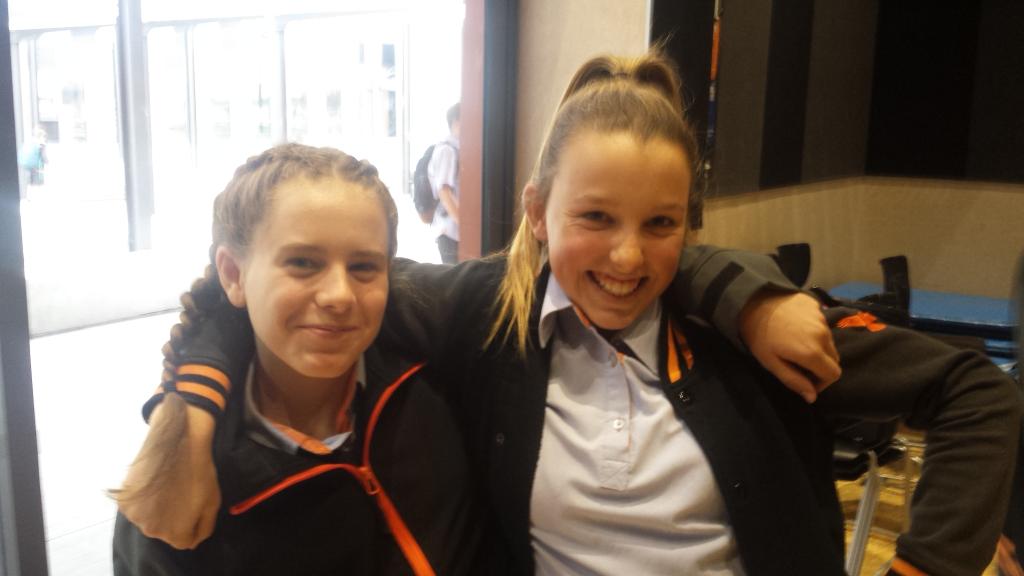
My Awesome Tour Guides
My second session was about using STEM (or STEAM) in the classroom. We were given a fun, hands-on activity to complete, which led into a discussion on the nature of science and how we can make science more relevant.
Here's a video of my creation. We had to make something that would keep the ball moving for as long as possible.
The second day of the conference began (after we shared our possibilities pitch) with my presentation. I was sharing ways in which coding (or, more specifically, Scratch) could be used throughout the curriculum. I had previously shared this idea at two educamps, so I had had some experience in what worked and what didn't. I tried to make my presentation less about me talking (because really, who wants to hear me talk for over an hour?) and more about people getting a chance to do something. So I just introduced Scratch and gave my attendees (all 9 of them!) some challenges to complete. With such a small group I was able to have lots of conversations and support a very diverse group of people - a couple of them had a lot of coding experience, while some had never coded before. It was a great session, I thought. I think in the future, I will always need to make sure to have my presentations as active, instead of passive.
My last session was with Andy Crowe who was sharing some things we can do as a Lone Nut in his Lone Nut Toolkit. He shared lots of design thinking and lean startup ideas and we worked through the Squid chart, which helps us get to the real questions we should be trying to fix in a problem. It was an interesting session, to say the least. I'm personally not someone who sits down and maps things out in charts. I just tend to do stuff, which can be problematic for me at times. So now I have a way of being "accountable" (in quotes because I think it's a dirty word) and mapping out my thinking when I do something different.
Like all of the PD that I've been to recently, this one was most valuable for the connections. What people said wasn't necessarily valuable (though, much of it was), but just making those connections and finding others in my tribe is what makes all the time and effort worth it. I no longer feel like that lone nut. I am definitely looking forward to spending more time (online, but preferrably face to face) with my newfound tribe!
Code Club keeps chugging along. Most of the issues that are coming up are minor - and related to my (mis)management of time. That being said, the majority of the students in the club are just coming in, doing the activities and then leaving. It's a bit like herding cats at times, but I'm not too worried. I wanted to give students an opportunity to code and LEARN some coding. I feel like I'm achieving that. I don't need to limit them by stopping. I will be trying to share a bit more.
One thing I want to talk about is girls in coding.
A common theme today is the lack of women in coding/computer based jobs and being represented in university Computer Science programs. I could cite many different articles (ok, I will: here, here and here for starters). Without going into the various reasons behind this, I feel like as a teacher I should try to do something to correct this balance. Why can't my girls gain these skills and enjoy doing it?
Will one Code Club at a school in New Zealand make a dent in the statistics? Probably not. But the message, once spread might. I've always thought that as a male teacher, I brought some value that my female colleagues could not bring (that's not to say they don't add anything that I can't, but there are far fewer males teaching young girls and having a positive non-relative male role model is quite rare for girls) - namely that I could encourage them, as a male and show them that it is a valued skill in them. I'm hoping that my job is one of keeping the flame lit, rather than re-igniting it.
Have I done anything out of the ordinary for the girls in my club? Not particularly, except I've encouraged them (which, I guess, could be more encouragement than they're getting from other sources). I was quite pleased with the number of girls I had this week. On Tuesday, I had about 3 times as many girls as boys. And honestly, I don't see any difference in their ability to code. One of the stars of my club is a girl in my class. I don't think she has a lot of experience, but she is enjoying it and has been eating up every new thing she can - she even comes both days I hold the club. That's dedication.
In my search to find information about this, I also found some resources for anyone interested in encouraging girls to code. Here are some of them:
I feel this is a very relevant area in all things STEAM. I'm not sure what direction this will lead me at my school this year and beyond, but I do have some plans. If you've got some girls who are really good at coding, there is always Lilypad Arduino as well that can be used to make wearable technology and clothing - though boys can play with those too. I've ordered some and am in the process of trying to figure out how it works (because as much as I may know about coding, it's not really that much.
If anyone has actively gone out and promoted girls in Coding or STEAM, I'd love to hear from you. I may not start implementing new ideas in the coming weeks, but every idea is a spark that is very hard to extinguish in my head.