Pages

Showing posts with label PTC 12:Inquiry. Show all posts

Friday, May 26, 2017

Organizing an ILE (Part 1?)

So one of the things that has been very apparent in my first term and a bit anchored in a Habitat at Ormiston Primary is that organization is both key and very messy. The more innovative things you try, the harder it is to actually make them work because there are so many moving parts. Over the last few weeks we have introduced a lot of choice for our learners and a few issues have cropped up.


  1. We want to make sure we know (and the learners know) where they are going and when without having to stop and call out every learner individually or write all 90 learners every day
  2. We want to make sure that every learner actually does attend workshops (a common question we've had from educators who we've spoken to)
  3. We didn't want chaos or to spend lots of time sorting it out.


So with some ingenuity (and lots of trial and error!) I've found something that is working (for now). This is a multi step process, but once it was up and working, it's actually quite quick to sort out.

The first step is that in our weekly meetings, my fellow learning coaches and I choose the workshops we are going to offer (based on a variety of factors, which could be its own blog post). After that is decided (usually during our Tuesday meeting) we then make up a Google Form with those choices:


Now comes the fun part.  Initially I had just sorted them out by alphabetizing the results. But that took more time than I wanted to spend, so I used the filter formula in Sheets to get from this:


to this:


I made a separate page for our literacy and our math workshops.

For those of you interested, the formula was essentially this:

=filter('Form responses 1'!B:B,('Form responses 1'!D:D="Ideas"))

With Ideas being the name of the workshop. I've further simplified it by using this formula and only changing the headings as necessary.

=filter('Form responses 1'!B:B,('Form responses 1'!C:C=A2))

The A2 just references the top of the list. By separating these into lists it was very easy to cut and paste them into another document for displaying in the habitat:


The next trick was to make sure that our learners were able to look at these and know in advance where and when they needed to be. Having Apple TVs on all of our Habitat TVs proved to be a slight advantage. While I couldn't get our Google Slides to play sans device, I was able to use Flickr to create albums each day so that all the relevant information would cycle through the TVs throughout the day so that the information would always be accessible.


Each week, to save work, we "Copy to" the sheets we sort onto (eg. the Math Workshops) into the new Spreadsheet created for the new form.


But I wrote above that we also wanted to make sure we'd have all of our learners choosing workshops. One (clumsy) solution was for us to go in and check them one-by-one. But I don't like that and it takes a lot of time (and it's not visual).

So I did a bit of googling and found a very useful formula "on the line."

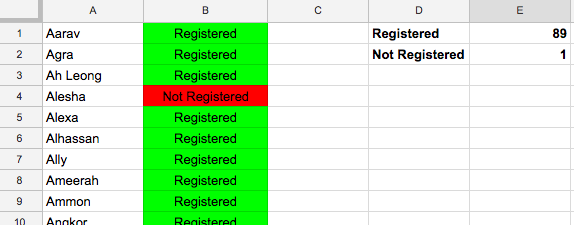
=IF(ISERROR(MATCH(A1,'Form responses 1'!B:B,0)),"Not Registered","Registered")

Essentially what this does is it checks the value in A1 (or A2, A3, A4, etc when you copy it in every line) and sees if it has turned up in Column B in the initial responses. So all I had to do was get a list of all of our 90 learners and put it in Column A and then copy this formula into all of Column B, add a quick conditional formatting (Green if it's Registered, Red if it's Not Registered) and this is what we get:


All but one of our learners have registered this week (and the one who hasn't is in Queenstown).

So that's how we're currently organizing our workshops. It seems like a lot, but once set up, it's very easily copied into a second, third, etc week. Hopefully this has been helpful. I'll make an attempt to share more of my organizational tips on here and if anyone has any ideas of how to improve this system, I'd love to hear from you!


Friday, May 5, 2017

Google Summits - Times Two!

This year I was fortunate enough to be accepted to present at both the Auckland AND the Wellington Google Summits put on by the Ed Tech Team.

Since the beginning of the year, as can be evidenced by my lack of posting regularly on here, I have been very busy and overwhelmed with the implementation of new ideas at Ormiston School where I was put into a habitat for the first time. So a lot of the drive that had previously been in me had slowly disappeared.

But these two Google Summits gave me my drive back. It's funny how you don't realize what's missing until you get it back, but I had mostly disconnected myself from my core online PLN and was suffering because of it. Coming back to these summits and spending four days with my tribe was extremely helpful in sparking my drive to make innovative change.


My four sessions went fairly well. Two were on how to use Mystery Hangouts (or Skype) in the classroom to connect with other classrooms globally and to promote critical thinking skills and problem solving, while the other two were on how to use Google Forms to make Choose Your Own Adventure stories. After some sessions last year that were more of me talking than of the participants actually, you know, participating, I made some changes and made sure that the majority of each session was a chance for my colleagues to try something new. For the Mystery Hangout session we ran a mock Mystery Hangout. For the Choose Your Own Adventure session we actually made our own Choose Your Own Adventures. Further to this, it gave me more ideas of what I could share in the future (and I'm going to keep some of that on the down low for now).


One tangent that these sessions sent me on was to create some sort of resource for teachers to connect with each other so that they can do a Mystery Hangout. I had used a padlet in my presentation to collect details of classrooms that might be interested, but on my long drive home from Wellington and after a suggestion from one of the attendees there, I am currently working on a small website for NZ teachers to find each other for these Mystery Chats (not trying to favour one over the other). So hopefully I'll find some time to complete that task soon and then share it with my PLN to get a global group of people who want to connect with NZ schools.

I also had the opportunity to attend several sessions at the summit which have led to some new thinking and tools for me to use in the classroom. Over the four days, I attended three (yes, 3) sessions related to Breakout EDU. Two which let me experience the game play (I've done it a few times before, admittedly) and once where we got the chance to brainstorm and look at the process of designing games. I'm actually quite interested in using this in the classroom (and we actually trialled it this week - but that's another blog post) so it was good to get my brain thinking about what we could do and how we could do it.


Another session I attended included using the G Suite Apps on iPads. This has long been an issue for me in the classroom/habitat. Often we say we have 40 some odd devices (for 90 learners, mind you) and 10 of those are iPads, which don't have the same functionality as chromebooks. However, we were given some tasks to try on the iPads and I managed to figure out how to do a variety of things on it that I had previously thought would be difficult to do.

There were also a few sessions on Computer Science and coding. One was a reiteration of the CS First session I attended last year, and this helped reaffirm the need for coding in the classroom. They have a variety of modules that learners can go through to practice coding. This got me thinking about the ways in which we can add coding to the curriculum and embed it through other subjects. I've made some tentative plans to work towards some practical, hands on coding in all areas. A second session I attended shared lots of resources for higher level coding. One resource that stood out in particular was the Khan Academy and Pixar joint venture: Pixar in a Box. Mainly geared towards older learners, there are certainly some aspects that can be used at the primary level. And don't think I haven't contemplated learning how to digitally animate and change careers! Probably not though...


I also finally attended a session put on by Angela Lee on Virtual Reality. Having worked with her for ages and ages, I've never actually gone to see her present. It was very helpful in that I now know how to use both Google Expeditions as well as another application that allows learners to make their own 3D virtual world: CoSpaces. These are two things that we're examining to add to our curriculum throughout as many areas as possible.

Overall, I was pretty pleased with the four days at the summits - and I quite liked the drive as well (it's always nice to see the green of New Zealand). It's given me a new focus going forward and sparked that fire in me that has recently been in hiding.

Thursday, January 26, 2017

Back From My Disappearing Act or Welcome to 2017!

So, I've been a little absent from the online community for the past few months. There have been various reasons for this, but basically life was good and then it wasn't. Both the good and bad events made me think deeply about what was important in my life. Some things were missing (and to a degree still are) and it caused me to ignore a big part of my life - my career.

Without going into details (I want to avoid giving TMI), there were some issues about the people surrounding me in my personal life (though, I should also credit the amazing and supportive people who helped me through this - and continue to support me in many ways). Being a foreigner who moved here along about 5 years ago, I do not have a support network. It has been difficult to deal with the stresses of being a teacher and of being a person in that context.

I think the thing I learned, or rather the thing that was reinforced, is that every educator needs a good support network beside them. Every educator needs to have something beyond their school - a reason for working. Despite many of us viewing our career as a calling, at the end of the day it is a job and we need something beyond that.

That being said, today was my first official day back from the holidays and though I was not in a great headspace I feel in a much better headspace. I can't say I'm quite ready for the new school year, but I'm definitely feeling more ready for it than I was a week ago.

Today we did a lot of different sessions on a lot of different topics. My biggest takeaway from the day was a session we did on collaboration. We were put into groups and given the following task: Work collaboratively to lift one of your team members as high as you can. After some great ideation where we all shared some amazing ideas and built upon each others' ideas we decided to use the elevator to lift one person. When we went downstairs to actually do it, we came up with a variety of other ways in which we could not only lift our person (we lifted her into a chair and then lifted the chair up) but also how we could collaborate (we had a pretty long chain reaction of people that got her into the elevator and pushed the buttons).

Afterwards we discussed the skills involved in collaborating and realized that we need to be cognisant of teaching the specific skills that learners will need when we ask them to collaborate. As adults (who are used to working in teams) we often forget this fact as we have learned this skills over time. When our learners come next week, this will be a good place to start with, as we'll need to get to know each other and do team building activities. I'm looking forward to creating a collaborative habitat this coming year.

Later in the day we discussed one of the unique ways in which OrmPS shows learner achievements and progress: Narrative Assessments. For more information, I'm sure someone will be sharing these at an educamp or Google Summit or uLearn, but to make a long explanation short, they basically show what learning was done, often with pictures and other artefacts and include next steps. They are to make learning more visible and not just ticking boxes. To practice making these, we watched the video (below) and worked in teams to make a narrative assessment of the man in the video.


Going forward I'm going to look at ways in which I can do these narratives in an innovative way, so any ideas are appreciated in the comments (though we do have lots of ideas that we've discussed and tried at OrmPS already).

Monday, October 24, 2016

Science Unleashed: Making Motorized Cars

I'm super far behind on my blogging. I've actually already had the third Science Unleashed lesson, but I've not written about the second.

After the first night, I was very excited to get back to the North Shore (without the wrong turns this time!) and see what Chris had in store for us. When I walked in, there were a variety of some really cool things on the table: motors, cardboard, propellers, battery packs. This was clearly going to be a fun evening.


We were again working in partners and our task was to make a vehicle that moved. We had a certain amount of time to build our first prototype and test it, with very little direction - except for the basic concept of the car and how we could potentially make it. My partner and I quickly discussed what we wanted to make and divided up the tasks. We made our vehicle quickly and when it didn't really go, we looked at the problems - the wheels were a bit sticky and not turning easily, the motor didn't have enough power - and decided how we would modify it.  We made smoother wheels and added a second battery pack (some may say this was cheating, but I'm not among them).


Here's a video of how our test worked out at this point:


Afterwards we had the conference like we had the week before, but instead of just discussion what we could potentially test and change, we came up with a plan of who would investigate what. We ended up looking at whether or not weight made a difference or if more power made a difference.  When we tested these as a group, ours went quicker than everyone else's - most likely because of the extra battery packs.


Again, we had a discussion on how we could improve our vehicles.

What was interesting today was not necessarily what we did, but how our scientific community evolved from week to week. We learned from our mayhem the week before and became more organized in our methods, which led to us being more successful in coming to a consensus in the end. I'm going to give Chris the benefit of the doubt and say that this was his plan - get us to create our own community. I look forward to the last two sessions (spoiler - the next one was pretty good too!).

Thursday, October 6, 2016

Hosting a #digitaledchat for #MakerEdNZ

Recently, I was give the opportunity from Stuart Kelly to host a #digitaledchat on #MakerEdNZ. I was very nervous about this proposition, but was also excited about the chance to not only run a major, international chat, but also to learn from others and start the conversation.

It was very difficult to set the questions as I wanted to encourage lots of rich discussion, but I also wanted to make sure that the talk was accessible. I initially made a few too many questions, so that I could whittle them down to the best ones.

In the end, I settled with the following 6 questions. None were earth shattering, but I felt that they would direct the discussion and help bridge the gap between the early adopters and those who were just learning about maker spaces for the first time.


  1. What is your experience with makerspaces?
  2. How would you define a makerspace?
  3. What barriers have you had or do you have in getting a makerspace in your school?
  4. What are the benefits or disadvantages to letting learners make or create whatever they want?
  5. How much direction do you think should be given in a makerspace?
  6. What are you going to do to either add to your makerspace or start one?

I wanted to focus on building the base and getting people motivated to start trying these things, which is one of the main reasons I started #MakerEdNZ

The chat went fairly well, and we had some good discussion. A transcript of the whole thing can be found here.

One of the first things that came out of the discussion was actually what a maker space is. Many schools probably have such a space and do maker activities, but they wouldn't necessarily call it that. Perhaps this is one of the realizations that we need to encourage in NZ schools so that educators can start thinking in terms of building on what they already have, rather than having to start a new thing that they've not heard of before.

We even came up with a new word: Thinkering, which given the mix of thinking and tinkering gives a great description of what learners would do in a makerspace - both expanding their mind and using the materials they have to create something.

Many of the barriers to makerspaces starting up were ones that we have heard before: time, money, space, a dedicated staff member, leadership buy-in. These are all things that need to be addressed, though one of them was seemingly discussed as an easily solvable problem. Maker spaces do not need to be full of expensive equipment. Many schools get by with using completely recyclable things, which are very easy to get within the community. Other barriers will need to be given a bit more time, but another purpose of MakerEdNZ is to help get through these.

Many teachers saw providing maker spaces as a positive way to encourage creativity, problem solving and to provide open ended problems. Some worried about wasted time and wasted resources. I've certainly cringed when I've seen my students spending hours on something, using a whole roll of tape in something that won't likely turn out to be useful, but the process of this does hold some value in my opinion. Thought it is tough to see all that wasted tape. Some other teachers echoed this sentiment during the chat as well.

Most teachers agreed that as little direction as possible would be best, though there is a need for some up front direction so as to keep children safe and to provide them with a starting off point. This has shown to be key for me and my learners and after some initial difficulty with the freedom of choice, they were able to become independent and self-directed quite quickly and easily. It's that getting lost or stuck that promotes real, authentic learning.

The actions that teachers are going to take are varied. Some were going to start using the term maker space, while others were very specific in their ideas going forward. Several wanted to get donations of materials for their spaces and find ways for learners to start making.

All in all it was a great conversation, and one that I hope to help continue. It definitely clarified what a maker space is for some and it got others starting to share with each other - an activity that will be key to growing the movement here in NZ.

I look forward to the next chat that I'll be able to host, whether it takes the same format or it pushes a bit beyond. Either way, this was a valuable experience and an important step forward in the #MakerEdNZ journey.

Thursday, September 22, 2016

Exploring Literacy and Coding

A while ago, I participated in a wonderful Twitter chat with #digitaledchat where we discussed what you could do with robots in class, such as Sphero. One of the things that came up was using them to create stories or videos by coding the robots as characters. I liked that idea so much, it got me to thinking quite a bit about how coding and literacy could be combined.

I've tried really hard to make my class a creative one, in which my learners are able to explore different ways of learning that are fun, creative and exciting. I want the children in my charge to wake up in the morning, excited to come to school and do their work (which they won't see as work). I have had many different ways of making stories and being creative (including Stop Motion and Digital Storybooks) so it wasn't a big step to try some new things. Here are three ways in which my learners used coding or computational thinking to create stories:

Choose Your Own Adventure Stories Using Google Forms

Many of us have read these books as children and this idea is definitely not a new one. You can use the "go to page based on answer" feature of multiple choice questions to direct readers to new pages based on their choices. When we first did this, I used Google Drawings to plan out the story (it can get very complicated if you have a lot of choices) but it isn't always necessary. A pair of my learners created this story earlier this year.


There are other ways of making stories like this, including Scratch.

Stories on Scratch

This idea came from CS-First.com where you can find a whole 8 lesson module on coding stories for code clubs, though if anyone has used Scratch Jr, that's basically what that app is for. The idea is simple: code the sprites to speak to each other and interact. As coding knowledge increases, so too does the complexity of the stories. This is definitely an area to explore for reluctant writers who happen to like coding (and I've noticed the majority of my learners are liking coding more and more everyday, some even attempting to code a Choose Your Own Adventure story).


Coding Robots to Tell a Story

This was the big idea from #digitaledchat that I have been waiting a while to try. We only have made one attempt at this, but it went, in my opinion really well. Some interested children joined me for a short brainstorming session. We came up with some characters and starting thinking about what their story was going to be about. Some other learners got interested and joined us at this point and the discussion started taking off. I backed off and let them sort things out. There were varying levels of coding abilities in the group and they were able to support each other. A lot of the story didn't really utilize coding knowledge, but it was a fantastic start. Again though, a little disappointed that these children won't get to try this again with me, but I'll keep on introducing these ideas to children and see how they develop.


The plan with this topic is to continue to explore it further, get children making more and more stories using their coding skills and then to share this in more depth next year (hopefully at GAFE & ISTE). So keep an eye out if you're interested as I think this is an exciting way to develop a plethora of skills amongst learners.

Wednesday, September 21, 2016

Lego Stop Motion Fun!

For those of you who know me and my classroom, you'll know that I have a massive collection of Lego, including many, many minifigures. My learners this year have, with much collaboration, become very creative with the Lego, building houses, cafes and many other things with incredible detail. A couple of my learners have even gone so far as to make a number of stop motion videos, but in the last week they've taken things to an entirely new level.

When I first introduced Stop Motion to my class, we had been using Stop Motion Animator on chromebooks. I had some webcams that worked (though the majority of the ones I bought did not) and that was going fine. Then we had some issues with the saving, so it became very frustrating to see my learners put a lot of effort into their videos and then be unable to save things. So we tried Monkey Jam on the class desktops. There was an improvement in being able to save an export, but it was still a cumbersome process.

Then we tried the Stop Motion Animator App on the iPads. Brilliant. Great resolution, easy to use, easy to add audio and easy to upload to Youtube. Over the past few days, the big sets have been used to create some really elaborate and creative stories from two of my students. I especially enjoyed the way they used Lego bodies with no heads as clothes. 


For anyone thinking about maker spaces, this is one way I have used my maker space to help develop literacy skills. Have a look at what they've done. My input was solely to provide the Lego and show briefly how to make a stop motion video. I'm really impressed with the direction they took with minimal direction. I think it goes to show that learners (of all ages) need an opportunity to explore. The first Lego creations and stop motion videos we did this year were not very exciting, creative or well done. But given time to try lots of things, they've been able to produce some amazing this. I only wish I could give this group of learners more time to develop these problem solving and collaborative skills.

Monday, September 19, 2016

Passion Project Sharing!

Today, after two attempts at Passion Projects and much reflection, my class had our first real celebration of our learning. And it was amazing! We had invited parents and some other staff members to come in for about an hour to find out what my learners had been doing all term. Last time we shared, we had each group or individual go up and talk to the class. This time, after thinking about it, I decided to try doing a fair of sorts. We had one learner who wanted to go up and present (see the video) and the rest took turns at sharing their work at tables throughout the room.


We had about 10 parents join us today and they were all amazing. They went around to each of the tables, talked to all of the children and asked lots of questions. It was such a positive and inspiring day and though I know I did do things to support my learners, this came almost completely from them. They were super confident and I was so proud of every single one of them. See below for pictures of the day.

How might I do more and better HTML coding?

Why do diet coke and mentos react?


Why do scientists invent so many things that are a waste?


How might I encourage people to like school?

What can we learn about nocturnal animals?

How might we make home-made jewelry?

Binoculars

How can I learn to code a website?

There was a buzz in the air?

How can I make a model of a wolf?


How can we make a house?

Sunday, September 18, 2016

Revisiting my Mixed-Ability Reading Journey

I had written a whole long post on this topic last week, and was just waiting for some data to finish it up, but then something tragic happened, and it all got deleted by accident (ctrl+z did not work!).  So I'll try my best to recreate what I had written (and perhaps it will be better).

Two terms ago I changed the way I taught reading. I was souring on the effectiveness of achievement (ability) groupings in everything and this was the last frontier.  I wrote some initial thoughts after one term, but now I have some data to back things up. In those two terms, 19 of my learners participated in the mixed-achievement groups, reading two novels over the two terms. This change started in early May and the latest results have come during early September, so the time frame is approximately 4 months. Over those four months, the average improvement in reading age has been 9.9 months, more than double what would be expected The smallest improvement was 3 months and the largest was 21 months. Though this is not exactly a scientific study, it does show that a) I'm not crazy for doing this and b) even if the reasons for their improvement did not include the way I taught, it's clear that the mixed-achievement groups does not hinder learners from improving and the children are not subjected to who is in the lowest group. I wish I had taken some other data at the beginning of this (asking learners if they enjoy reading, if they think they are good at reading) as that may have been more valuable, but anecdotally, the class tells me they don't want to go back to the old way.

Furthermore, while looking at the reading results, I had a look at my writing results as well, a subject in which I have not had achievement groups all year. On average, compared to their term 1 Asttle results, my learners have improved an average of 3.1 points on the scoring rubric, which translates (roughly) to 1.5 sublevels, which is approximately the amount of progress expected in a whole year. So overall, my students have improved more than what would be expected over that time.

Given the improvements, I have spent some time thinking about why this might be, and I came up with several reasons:

Choice
Though the choice I gave my learners was not very big, I let them choose from books they would enjoy (Roald Dahl) and didn't force any particular books on them (in fact, there was a multiple step process to figure out which books to read, each step involving learner voice). Having children choose what they read puts a lot of the ownership back onto them, they want to read those books, and they are excited to talk about them.

Discussion
A lot of the work was based around discussions and questioning, directed by both myself and my learners. Since all learners came from different backgrounds and experiences, mixing up the groups provided for richer discussion and thought about the books. Children who have never worked together before had a chance to share their ideas with each other. This is always a good thing, getting ideas and ways of thinking shared between learners, and having them support each other in developing their comprehension strategies.

Enjoyment, not Shaming
Most children who are not in the top group do understand what this means. By focusing on enjoyment over achievement (on an arbitrary scale) learners are more engaged and enjoy reading more. When reading is enjoyable, they do it more often. When they do it more often, they get better at it.

SOLO Maps
Most of the work I do with the groups for their novels, revolves around SOLO maps and using them to understand the book a bit better. From the first to the second term, there was a marked increase in confidence of students using the maps, to the point where some didn't even need me to walk them through it. They were able to think about what happened in the book critically and delve deep into the meaning of what the author wrote.

Harder Books
Rather than give learners books that are "at their level," more difficult books (which are chosen by the children) push them to learn more. They are motivated to read the harder books and when they go back to their levelled tests, they seem much easier by comparison, which helps them succeed more easily.

Overall, I'm extremely pleased with how this reading (and the writing) program has gone this year. My learners are clearly more confident with their learning and sharing what they know (though this is not just because of the reading, but it has played a part in it) as well as working as a team. Incidentally, it has been harder to prove an improvement in math results this year as it is not as easily quantified (or at least I haven't yet tried to do so). Has anyone else tried mixed-achievement reading? Has it been successful? Any comments would be greatly appreciated.

Thursday, September 8, 2016

On Stepping Back and Watching

For a lot of my teaching career, I have been told that I must be doing something with the students. That maximizing time with me is what will make the difference for students. A buzzword that some principals and other leaders like to use is "direct acts of teaching." Our days are structured by how many groups we can see, as if this makes all the difference in the world.

But I'm here to ask if perhaps we've got it backwards. I'm not saying just let children be all by themselves the whole day - that has the potential for disaster (though I am somewhat interested as to what would happen if that were the case). I'm talking about pulling back and letting students have a go; letting them have a chance to make their own meaning and work through problems their own way.

A big focus of my teaching the last couple of years has been using the problem solving approach in mathematics. In it, I give my students some problems. We discuss what they might mean beforehand, then I let them have a go. Often I just step back and go help the other learners in the class and let them struggle. I've even gone so far as to ban children from asking me questions during their work time. I will drop in and out of each group, asking them to explain what they're doing (and sometimes even doing those - unplanned - direct acts of teaching, if necessary).

The struggle itself is what helps learners learn and grow. I could tell them what they need to know, but a) I doubt very much they're all listening, b) they all need to know different things, even learners who have achieved to a similar degree, and c) learners can and want to learn anything, so who am I to dictate what they should be learning by completing any given activity. There's even evidence that this gives bigger gains in the long run.

More recently (probably in the last few months), I've started doing this more, in other areas. Passion projects are a great way to do this. I've also stepped back in writing and have allowed my students to complete a writing project of their choice - which can range from writing a book to making a stop motion video. Everything we do, I want my learners to grapple with the ideas themselves, experience failure, and then move forward. We are risking the creation a generation of students who merely want to please someone else by spoon feeding them what they need to know.

In writing, I have also begun getting students to evaluate their own work. It was very successful this week. I had taught a quick mini-lesson on improving our vocabulary in our writing and the students went off and wrote on their own. Afterwards, I had them work with each other to identify the interesting words they had used. I watched the whole thing, but the conversations and debates they had ("Is Palmerston North an interesting word?") were much more valuable than me telling them or giving them a worksheet. I even joked during this time to them: "I'm not doing anything". But one student said to me: "Yes you are." They get it. They know it helps them.


There are definitely some interesting perspectives on this. Oftentimes, as teachers we need to feel like we are doing something, as explained in this article. However, I think we need to realize that we can be extremely effective by putting learners into positions where they will struggle and be able to figure it out for themselves.

I also came across this story a while back about WALTS (learning outcomes, objectives, etc for those not down with the lingo) and how they limit learning. Letting students learn their own way means that we shouldn't be dictating the learning outcomes. We can give them a task, but what they learn can be different from one student to the next. Just some more food for thought.

Tuesday, August 30, 2016

The Case for MakerEdNZ

Since going to ISTE this year, it has become apparent that there is a gap in New Zealand education, at least from my perspective. That gap is makerspaces. Now, I know some of you will be reading this saying: "What are you going on about? I've got an awesome makerspace in my school! You don't know what you're talking about." And yes, you'd probably be right, I DON'T know what I'm talking about. Yes, there are lots of great and amazing makerspaces in New Zealand. However, when I asked the NZ Teachers (Primary) Facebook group about makerspaces, only 43% of the teachers had even HEARD of them and only 11% had one in their school. So I say to you people who have the makerspaces: "How can you help the rest of us?" (note: I'm actually in the 11%, so the question should be: "How can we help each other?")

Instead of getting worked up about it and saying that either: a) it's not fair, I want some cool stuff, or b) what's the point, someone else will fix it, I've decided to do something about it. And thus: MakerEdNZ was born. What is it, you ask? I'm not entirely sure. It's just an idea right now (ok, well actually, it's more than just an idea - but more on that later). But the idea is that we (the keen makers out there, those with makerspaces, and those who just want to bring them to NZ schools) can work together, share what is working for us and get those makerspaces into every New Zealand school. Ambitious? Check.


How this plays out is anyone's guess right now, but I believe that there is the desire to make this change, and that desire will increase as more and more teachers, schools and BOTs see what can happen in a makerspace and the real, authentic learning it can create.


I am currently in the process of applying to two separate programs to help me along in this journey. After being unsuccessful in my first application to the Google for Education Innovator Academy, I was speaking to an Innovator friend of mine about this very idea and it was suggested that this be the project I use in my application. And that's when things got real. When I started thinking about MakerEdNZ in those terms, I got a little more into it and have started work on a variety of angles of it (sneak peek: there's a website in the works, videos being planned, as well as twitter chats and many other ways of sharing) and have started thinking of it on a grander scale. I've literally just sent my application in for that. I'll know in a week (and so will you) whether or not I'll get the support of the amazing innovators at Google to help realize this vision of mine.


The second application I am working on (though mostly completed) is for the CORE education efellows. This will allow me to undertake some action research which will help me make the case for Makerspaces in New Zealand schools (something that would be amazingly helpful in convincing schools and BOTs to help find the space and resources for makerspaces). That application is due next week.


Whether or not I get into both or neither of these amazing programs, this initiative is going ahead full steam (But if you're reading this at Google or CORE right now, don't think that I don't want your help. I think being supported by both of you would really make this idea fly).  So if you're reading this thinking "I'd love to help, but I don't know how I can" leave a message on this post, follow me on twitter (@michaelteacher, @MakerEdNZ or our hashtag #MakerEdNZ), or get ahold of me in another way. We need knowledge, skills and experience, but more importantly we need people who want to make a change and be a part of something amazing. We'll work on the knowledge, skills and experience together. 


So why do this? What's the point of makerspaces. New Zealand education is fine you say. I have to disagree. Not to be disrespectful, but in my experience, way too many students have become disengaged with their education, right from the beginning. The looks on their faces when they are forced to sit still and listen is painful to me as a teacher (and yes, I know this is not the case everywhere, but it is in a lot of places). The lack of a chance for students to be creative and to make things is scary. Busy work and worksheets reign supreme in some schools and many students are left feeling like school is a prison, waiting excitedly for the end of the day and the weekends. Incidentally, as my students have been given more opportunities to make and create, the "Is it lunch yet?" questions have since been replaced with me trying to kick my students out of the classroom at playtimes. Is this not what we should all aspire to: students who actually want to be in school. 


It is absolutely imperative in 2016 that we listen to the voices of our students. What do they want to learn? What skills do they want to try? We need to provide opportunities for students to learn a variety of skills (or just learn how to learn new skills) and expose them to technologies - old and new - that they wouldn't normally get exposed to. We can do better for our students. Would we want to be a student in our own classrooms?

MakerEdNZ has the practical goal of making makerspaces available to all New Zealand students, but the aspirational goal of making every student wake up in the morning and want to go to school to work on their projects. 

In writing this, I've also come up with a great new slogan for MakerEdNZ:

MakerEdNZ. Making students want to stay in class during play time, since 2016


Friday, August 26, 2016

Passion Projects: A-learning We Will Go!

Last term my class started Passion Projects after having tried it last year at my last school. I had meant to write an update as to how the finished products went, but never found the time in a busy schedule straddling the last holidays. The presentations students shared (with myself, the class, our Principal and one Deputy Principal) were a good start. There was some nervousness. The students had mostly put a lot of effort and thought into their projects and it was great to see them share what they learned. But there were many things that could be improved - a lot of which fell on me. Preparing the students better was a priority of mine. Exposing them to better and more interesting ways of sharing what they've learned was another. We had a big reflection after the first round and then again when we started the second time. Students had a better idea of what was expected and way less time was wasted getting started.

This term I have stood back much more than I did last term (at least after the initial reflections) and have let my students explore their questions and take them in their directions. I probed when necessary and helped out when asked. But it was this week that the changes that had been brewing silently finally came bursting out in full view.

What was most startling was the variety of things students were doing this term. Many were using our classroom's Makerspace to create something. Some were coding. But it was apparent, the students were all enjoying what they were doing and were fully engrossed in their projects.


I think the biggest issue during the first go around of Passion Projects was that students were actually a bit tentative when it came to making choices about what they wanted to learn. They were a bit afraid of the choice and choose ways of sharing that were known, and thus easier. Now that they've had a chance to try it, they have begun to try new ways of displaying their information. And no doubt, my understanding and increased comfort level with the chaos has helped. 


As a teacher, the idea of letting go was not one that was difficult to come to grips with. I want my students to have choice and control over their education and learning. On a practical side, that isn't always the case. I'm constantly afraid someone will get hurt (hot glue gun, box cutters, kids being kids) or a massive mess (paint, glitter), Legos being lost or sucked up by the vacuum after school, or just things generally being broken or wasted. This does happen occasionally (usually not the getting hurt though) but it's just something I need to get over. Trusting the children is key and they will often surprise you if you give them real trust to learn their own way.


The students have become proud of their work as well, though they have been a bit hesitant to share their work. When they do, everyone has been extremely supportive of each other. It's not just the fact that students are choosing what they learn and are engaged - they have also become a supportive learning community. This has been key in their transformation.


I borrowed a Ricoh Theta this past week to make another video and tested it out by taking this 360 degree video of the class during Passion Project time. I really enjoyed this day (and the whole week) as we have been doing real learning, not just the kind where I stand up in front of (or sit with) a group of children. It was an extremely liberating feeling for me to be able to give my students a voice. I hope that these lessons stay with them for life.


Thursday, August 25, 2016

ISTE 2016!

It has taken me a few weeks (almost a month, in fact) to fully come to grips with my ISTE 2016 experience. To sum it up in word: Amazing! But obviously there were some really good takeaways that came from the experience. I'll try my best to share all of what I learned, but no doubt some good stuff will get left out.

edit: Now it's almost two whole months after ISTE! But still thinking lots about it. Some of this may be repetitive because of the time between when I started writing and when I finished, but I think the tone that will likely be consistent throughout will convince you of the value this experience had for me and could have for you in the future.

People, People, People

The first place you need to start when dealing with ISTE is the people. I'm not talking about the sheer number (though that is staggering on its own). What I'm talking about is the people you meet. The biggest draw for something like ISTE is to meet lots and lots of like-minded and incredible people. And don't get me wrong, EVERYONE at ISTE is incredible. When I told one of the people I met that "I'm just a classroom teacher," she responded by saying that nobody is "Just" anything. We all have something to offer, no matter the title or experience. Though I did realize this before, it was interesting to see how our language can affect our perceptions (and the perceptions we create in others). Later on that day, I met someone who said pretty much the same thing about being "just" something. I was spurred on to share my new perspective.

There are also countless opportunities to meet and connect with educators around the world (well, mostly the US). There is so much value in this for all of us and our students who will benefit from these connections. I made a concerted and deliberate effort to seek out new people and talk to some who I wouldn't have otherwise spoken with - including the CEO of ISTE! I made several great connections which will help me make further connections in the future. It's all about the people. If that were the only result of the week in Denver it would have been worth it completely.

On top of meeting people at official conference events (probably the best source of that was the Global Ed Day - a great group of people to connect with, if you're looking), there were several social events which turned out to be just as valuable. I had made it my mission to find the "seedy underbelly of ISTE" this year, and while it definitely wasn't seedy, it made the conference that much more impactful. My only regret is that I didn't find more events to go to. In all, I attended events put on by Wonder Workshop (happy hour at a restaurant), the Ed Tech Team & Symbaloo (Karaoke), Gaggle (a party) and OSMO (a Sneak Peak event). All of those events, helping to strengthen my PLN (personal learning network for the uninitiated). I was able to build on some of the connections I made a year prior and hopefully will be able to build on these ones in 2017 (because yes, I'm going).

New Things and Old Things with More Pizazz

Having been at ISTE last year, I found that there were a lot of things repeated, but with more development. There were literally tons of resources (if you weighed them all together, there is no doubt of this) showing how makerspaces and making can be used in the classroom. Many people were sharing how they've been using their robots (many of which I bought last year after ISTE) and other cool gadgets in the classroom. For example, there were many people sharing what they've done with paper circuits (a shout out to Chibitronics & Spark Fun who both gave me some free samples to use in my classroom) as well as robots (guess who won a free kit from Hummingbird?) One really cool startup that was sharing in the expo was Hyperduino which had some really simple applications with their custom built arduino boards. They ran out of free samples by the time I got to their booth, but I may pony up the dough to get one.

It seemed like everyone had a Dash & Dot, Sphero & Ollie and Ozobots. Not to mention Makersaces. Perhaps this, too, was one of my big takeaways from the conference, and (since it's taking me forever to write this reflection) one of the things I've been most active promoting since I've returned. While I'm fully trying to gear up my classroom's Makerspace, ISTE this year has planted the seed of a big idea in my head. I'm working now to start #MakerEdNZ, a community of schools and teachers who are using Makerspaces in their classrooms. I'll write a long post about it later, but for now, just know that ISTE inspired me.

Global Connections

The only actual planned event I went to at ISTE was the Global Ed Day 2016. What a great group of people. Again, this is something I want to explore in much greater detail. Yes, we've done Twitter chats and Mystery Hangouts, but those connections are only on the surface (but again, much, much better than no connections at all). A lot of the talk around the Global Ed Day was starting collaborative projects between schools on different continents. This is another area for leadership within New Zealand, I feel, and something that is many people are primed for. We'll see what comes out of this, but perhaps someone reading this will take the call to arms and run with it. I only ask that you please include me.

Things I've Been Using

So it has taken me 2 months to get this far in my reflection. But that provides a great opportunity to reflect upon how those new things are going. Probably the most immediate thing I tried was Seesaw. For anyone who hasn't heard of this before, I urge you to have a look at it. I was lucky enough to have it explained to me by a teacher at the Seesaw booth in the expo. It's basically like Facebook for schools. Using the app (on tablets, phones or chromebooks) my students can take pictures or videos of their work, record an explanation over top of it, tag themselves in it and just generally share their amazing ideas. They can like each others' work and make comments - both written and oral! And I've only scratched the surface of what I can do with it. So far my students have found it super easy and have enjoyed sharing.

I also re-met my good friends at Kiva, which got me back to teaching the Kiva U curriculum (in the small amount of time that I can fit it in).'

I've also given my students focus with the Student Blogging Challenge. Though we may have been a few months late, meeting some of the people who have set this up, got me intrigued. My students have had some ups and downs with it (some of them spent a whole week or writing time making an avatar, not saving it, then making a new one), but overall it has helped teach them about blogging a bit more.

Another, practical thing I saw at ISTE and brought back to use were all the paper circuits that were being shown. I was extremely lucky to have been given those starter kits from Chibitronics AND Sparkfun, so I had a go with that at school AND at some educamps. It was interesting to say the least and something I want to look more into.  I was also given the chance to make a wearable circuit with some Lilypad Arduino components:


One of the sessions I went to was actually done as a walk around Downtown Denver. The presenter was telling us that we should be getting our students more active in class, and building movement into every activity. I had previously had swiss balls in my class but had given them up because of some behaviour issues. However, he inspired me to pump them back up and get my students moving more often. A small thing, but I think it's something that's important.

Conclusions

I could go on for pages and pages talking about how ISTE has changed me and my practice, but my biggest advice is: Go next year to San Antonio! It will change so many things about how you see teaching and give you so many ideas to help you do so. It will give you connections that will change your idea of teacher-teacher relationships and the way our profession should interact. It was honestly the best four days of the last year for me. Unlike a lot of the New Zealand based conferences that I've been to, ISTE has made me feel that we lone nuts are much stronger in numbers. It's nice to have our smallish group here, but expanding beyond our shores, in my opinion, is never a bad thing. Being part of something so big, is truly empowering. Meeting so many genuine people who only want the best for their students is inspiring. So, I urge all of you Kiwi teachers (and why not all my Canadian teacher friends as well, I belong to two countries), come with me next year! Come join my tribe!